Dr.Vijayalakshmi Aluri, Winner of World Bank’s Projects competition, Author, Health Educator, Social worker, and Gynecologist, Sri Sri Holistic Multi-Specialty Hospitals, Hyderabad.
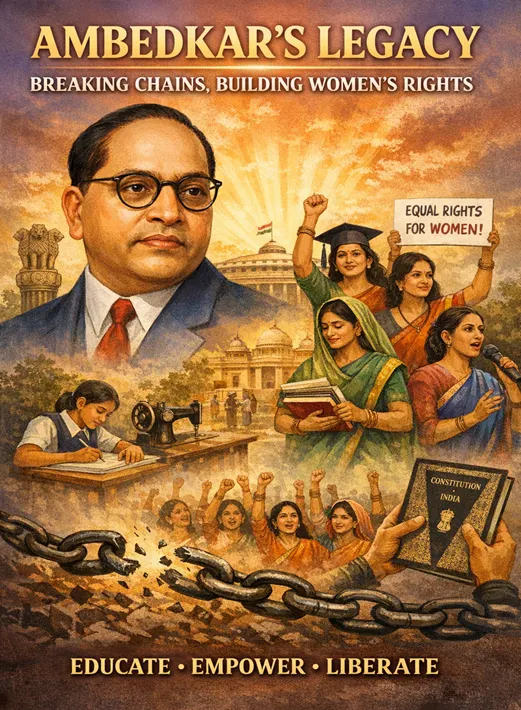
On a land weighed down by centuries of inequality, one voice rose with clarity and courage — not just for justice, but for dignity. B. R. Ambedkar did not merely speak about freedom; he defined it in a way that included those who had long been silenced — women.
At a time when women were suffocated by rigid customs, denied education, stripped of property rights, and forced into lives of submission, Ambedkar saw clearly that no society could progress if half of its population remained oppressed. For him, women’s emancipation was not a separate issue — it was central to the idea of true democracy and social justice.
Seeing the Reality Others Ignored
Ambedkar’s understanding of women’s struggles came from deep observation of society. He saw how caste, class, and gender intersected to create layers of discrimination. Women, especially those from marginalized communities, faced a double burden — oppression because of their caste and their gender.
He did not accept this as tradition. He questioned it. He challenged it. And more importantly, he worked to change it.
At a time when many reformers spoke about women’s welfare in limited ways, Ambedkar addressed the root causes. He understood that social customs, religious interpretations, and legal systems had all contributed to keeping women in a subordinate position. His approach was bold — change the system, not just the symptoms.
Education: The First Step to Freedom
Ambedkar firmly believed that education was the strongest tool for liberation.
His famous call — “Educate, Agitate, Organize” — was not limited to men.
He actively encouraged women to pursue education, to think independently, and to question injustice.
He urged families to educate their daughters, not as a favor, but as a right. He knew that an educated woman becomes aware of her dignity, her rights, and her potential. She becomes capable of making choices, raising aware families, and contributing meaningfully to society.
For Ambedkar, education was not just about literacy. It was about awakening the mind.
Legal Reforms: Giving Women Their Rights
Ambedkar’s most powerful contributions to women’s emancipation came through law. As the chief architect of the Indian Constitution, he ensured that the principles of equality, liberty, and dignity were not just ideals, but enforceable rights.
The Constitution guaranteed:
- Equality before the law
- Prohibition of discrimination based on gender
- Equal opportunity in public employment
- Protection of life and personal liberty
These were not small steps. They laid the foundation for women to stand as equal citizens.
But Ambedkar did not stop there.
The Hindu Code Bill: A Revolutionary Step
One of his most courageous efforts was the Hindu Code Bill. At a time when society was deeply conservative, Ambedkar proposed reforms that would fundamentally change the status of women in Hindu society.
The bill aimed to:
- Give women equal rights to property
- Allow women the right to divorce
- Recognize women as independent individuals, not just dependents
- Provide rights in inheritance
These ideas were revolutionary. They challenged centuries-old norms that treated women as secondary to men.
The resistance was fierce. Many opposed these changes, unwilling to give up traditional privileges. But Ambedkar stood firm. For him, justice was not negotiable.
Although the bill was not passed in its original form during his tenure, it later became the basis for several laws that improved women’s rights in India. His vision, though delayed, was not defeated.
Economic Independence: The Real Empowerment
Ambedkar understood that true empowerment comes with economic independence. A woman who depends entirely on others for survival often has little control over her life.
He supported women’s participation in the workforce and advocated for fair wages, maternity benefits, and safe working conditions. As a labor leader, he introduced policies that benefited women workers, including:
- Maternity leave provisions
- Equal pay considerations
- Better working conditions in factories
These were not just policy decisions — they were steps toward giving women control over their own lives.
Challenging Social Norms
Ambedkar did not shy away from confronting harmful traditions. He openly criticized practices that degraded women, including child marriage, enforced widowhood, and denial of basic freedoms.
He encouraged women to break free from oppressive customs and take charge of their own lives. He spoke directly to women, urging them to stand up, to organize, and to demand their rights.
He believed that change would not come only from laws — it had to come from within society, and women themselves had to be active participants in that change.
Women as Agents of Change
Ambedkar saw women not as passive recipients of reform, but as powerful agents of transformation. He encouraged them to participate in movements, attend meetings, and raise their voices.
Many women joined his movements, stepping out of their homes and into public life for the first time. They found in him not just a leader, but an ally who respected their strength and potential.
He understood something that remains relevant even today: when women rise, society rises.
A Vision That Still Guides Us
Ambedkar’s vision for women was far ahead of his time. He imagined a society where women would:
- Live with dignity
- Have equal opportunities
- Make their own choices
- Be free from fear and discrimination
While much progress has been made, his vision is still not fully realized. Gender inequality, violence, and discrimination continue to exist in different forms.
This makes his legacy not just historical but deeply relevant.
Carrying the Legacy Forward
Remembering Ambedkar is not enough. His ideas must be practiced.
Every time a girl is educated, his vision moves forward.
Every time a woman asserts her rights, his struggle continues.
Every time society questions injustice, his voice echoes again.
His legacy calls for action:
- To ensure equal education for girls
- To support women’s economic independence
- To challenge harmful traditions
- To create safe and respectful environments
This responsibility does not belong to one group alone — it belongs to all of us.
Ambedkar’s legacy
Ambedkar did not simply break chains; he showed how to build a future without them. His work gave women the tools to rise, the rights to stand as equals, and the confidence to claim their place in society.
He believed that the progress of its women is the measure of the progress of a community. This idea remains as powerful today as it was then.
As we remember him, the question is not what he did — but what we will do with what he gave us.
His legacy lives on in every woman who refuses to be silenced, every voice that demands equality, and every step taken toward a just and humane society.
Ambedkar’s work was not just about changing laws — it was about changing lives. And that change continues, one woman, one voice, one act of courage at a time.