Dr.Vijayalakshmi Aluri, Winner of World Bank’s Projects competition, Author, Health Educator, Social worker, and Gynecologist, Sri Sri Holistic Multi-Specialty Hospitals, Hyderabad.
Compassion is the quiet breath of humanity — without it, the human heart may beat, but it cannot truly live.
The Breath of Humanity
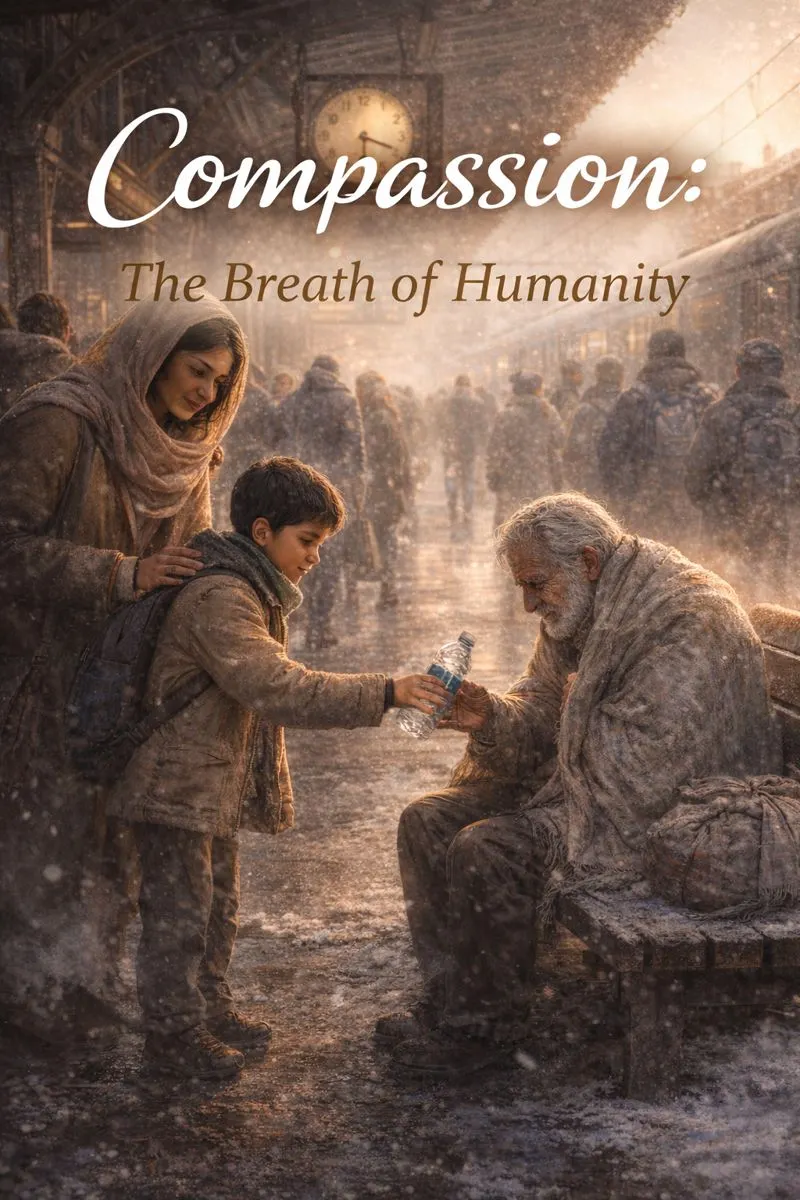
On a cold winter morning, a crowded railway platform stirred awake before sunrise. People hurried in every direction — vendors shouting, tea sellers pouring steaming cups, passengers clutching bags, anxious not to miss their trains. In the rush of movement and noise, no one noticed a small elderly man sitting quietly on a bench near the far end of the platform.
He wore a thin cotton shawl that did little to protect him from the biting cold. His hands trembled slightly, and his breathing was slow and uneven. Travelers walked past him without looking. Some were busy checking their phones, others arguing with ticket clerks, and many were absorbed in their own journeys.
For a long time, the old man sat there, silent and unnoticed.
Then a young boy, perhaps ten years old, tugged gently at his mother’s hand.
“Amma,” he whispered, pointing toward the bench, “that grandfather looks sick.”
His mother glanced briefly and replied, “Someone else will help him. Come quickly or we’ll miss the train.”
But the boy did not move.
There was something about the old man’s face — a quiet helplessness that stirred something inside him. He walked slowly toward the bench.
“Grandfather, are you okay?” he asked softly.
The old man tried to respond but could only nod faintly. His lips were dry. His breathing sounded strained.
The boy hurried back to his mother.
“Amma, he can’t breathe well. Please help him.”
His mother hesitated. The train announcement echoed through the station. Their train would arrive in a few minutes. Missing it would mean delay, inconvenience, and perhaps lost work for the day.
But when she looked again at the elderly man, something in her heart shifted.
They walked back to the bench.
The woman offered him a bottle of water and gently helped him drink. She placed her shawl over his shoulders and asked a nearby vendor to call the station medical officer. A few minutes later, two railway staff members arrived with a wheelchair and took the old man to the station clinic.
As they wheeled him away, the old man looked back at the boy.
His tired face softened into a faint smile.
“Thank you,” he whispered.
The train soon arrived. The mother and son boarded, finding a seat near the window. The boy sat quietly, watching the platform disappear.
After a moment, he asked, “Amma, what would have happened if we had walked away?”
His mother looked out at the rising sun.
“I don’t know,” she said softly. “But sometimes helping someone is more important than reaching somewhere on time.”
The boy nodded, absorbing her words.
That morning, nothing extraordinary had happened. No great heroism, no grand gesture. Just a child who noticed another human being, and a mother who chose to pause her journey to help.
Yet in that brief moment, something deeply human had taken place.
Compassion had breathed life into an ordinary morning.
Human history is filled with great achievements — monuments built, technologies invented, nations formed, and wars fought. But beneath all these visible accomplishments lies something far quieter and more fragile: the human ability to care about the suffering of another person.
Civilizations survive not only because of laws or systems of governance, but because individuals continue to respond to the pain of others.
Compassion is often invisible. It rarely makes headlines. It does not demand applause. Yet it quietly shapes the moral atmosphere of society, much like air sustains life without being seen.
When a stranger offers water to someone in distress, when a teacher encourages a struggling student, when a doctor listens patiently to a worried patient, when a child shares food with a hungry friend — these simple acts form the hidden foundation of humanity.
Compassion is the moment when the boundary between “my life” and “your life” becomes thinner.
It is the recognition that another person’s suffering is not entirely separate from our own.
In many ways, compassion resembles breathing.
We do not notice our breath most of the time. It flows quietly, sustaining us without effort. But the moment breathing becomes difficult, we suddenly realize how essential it is.
Human values work in a similar way.
As long as compassion flows naturally through families, communities, and institutions, society feels stable and humane. But when compassion fades — when indifference replaces care — the moral atmosphere begins to feel suffocating.
We start to notice something is missing.
Modern life often moves at a relentless pace. Cities grow larger, technology connects us instantly, and information travels faster than ever before. Yet despite these advances, many people feel an increasing sense of isolation.
News reports show suffering from every corner of the world — wars, disasters, poverty, loneliness. At times the sheer scale of pain can make individuals feel powerless. Some begin to withdraw emotionally, protecting themselves from constant exposure to distress.
In such moments, compassion can appear fragile.
But compassion has always been fragile.
It survives not through grand declarations but through countless small decisions made every day — moments when people choose to notice, to pause, and to care.
The boy on the railway platform did not solve the world’s problems. He did something much simpler.
He noticed.
And that act of noticing changed the outcome of one person’s morning.
Perhaps that is where compassion always begins — not with dramatic sacrifice, but with attention.
· To see another person clearly.
· To recognize vulnerability.
· To respond.
Many of the world’s ethical systems, religions, and philosophies speak about compassion as a central human virtue. But compassion does not belong to any single tradition. It emerges naturally from the shared experience of being human.
Every person understands pain.
Every person hopes for kindness during moments of weakness.
When someone responds to that hope with care, compassion takes form.
In hospitals, classrooms, homes, and streets across the world, countless acts of compassion unfold each day quietly. They rarely attract recognition, yet they keep the moral fabric of society intact.
Without them, human life would become harsh and mechanical.
With them, even ordinary moments carry dignity.
The story of the boy and the elderly man is not extraordinary. Similar moments happen everywhere — often unnoticed, often unrecorded.
But these moments remind us of something essential.
Compassion is not an abstract philosophy.
It is a living practice.
It appears in simple gestures: offering water, listening patiently, sharing warmth, or standing beside someone who feels alone.
Like breath, compassion moves quietly through the spaces between people.
When it flows freely, humanity thrives.
When it is withheld, something vital is lost.